We are Water Reflections: Page Public Library (AZ)

The following reflection was written by Debbie Winlock (Director) and Seairah Combest (Children’s Coordinator) of the Page Public Library in Arizona. APL was an active participant in the “We are Water” project from 2023-2026. We are Water is funded by the National Science Foundation’s (NSF’s) Advancing Informal STEM Learning (AISL) program, which supports innovative research, approaches, and resources for use in a variety of learning settings
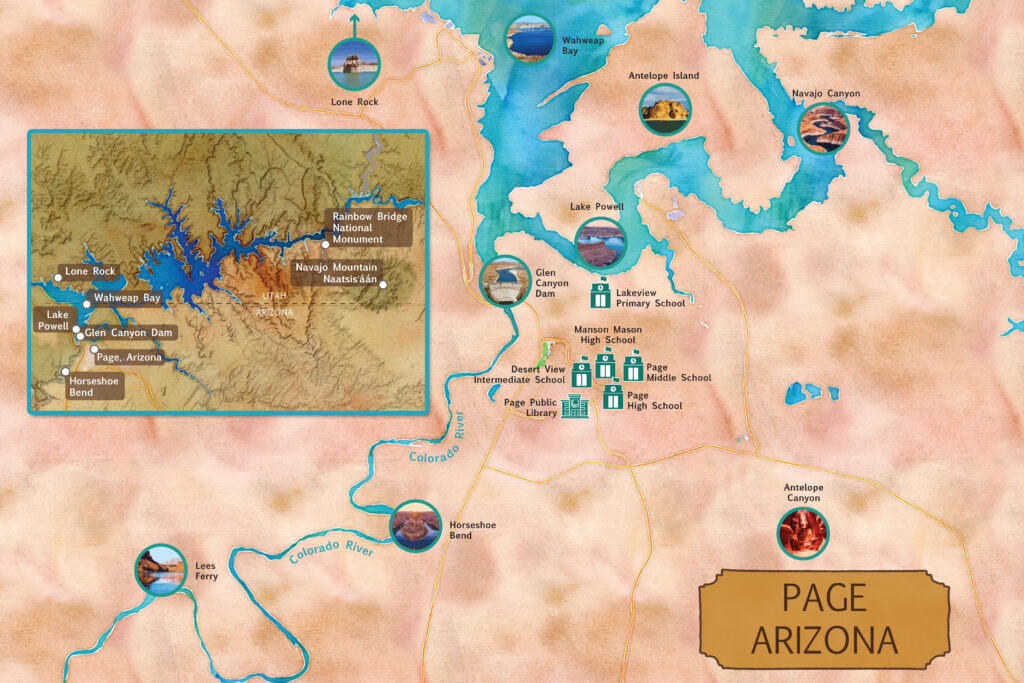
When people think of Page, they think of breathtaking views like Horseshoe Bend, the gorgeous copper and red hues painting the Antelope Canyon walls, or even the glistening Lake Powell, which holds memories for many. Although there’s so much to appreciate and love about what’s in our backyard. True beauty is found just within our community. A community that is extremely diverse, a community that is small enough that you recognize friends as family. A community that will look out for each other; that will come together in both the good and bad times. If you break down, someone will stop. If a family is in need, the community will gently hold that family up. A community that stands in the gaps, no questions asked. And there’s something so grounding about living so close to the Navajo Nation, our neighbors. You feel the culture, the history, the connection to the land in a way that’s hard to explain but always present. You can move away and come back to visit, and it’s like you never left. Truly a unique unity-driven community. We, locals, like to say, “Welcome to Page, America.”
Page Library wanted to be part of the We Are Water Project in Page, AZ, because water shapes every part of life in this region—environmentally, culturally, and economically. This project creates a space where community stories, science, and stewardship come together. We felt drawn to the opportunity to learn from local perspectives, contribute our experiences, and help strengthen our shared understanding of how water impacts our future. Being involved allowed us to support education, community dialogue, and collaborative solutions around an issue that deeply impacts our region. This project brought its own unique way of learning that connected with patrons of all ages. The project was laid out to enable staff to easily engage with, teach, and converse with patrons about water in our backyard. This project offered many hands-on opportunities for patrons to be involved and keep them involved. Because water isn’t just a resource here, it’s a lifeline, a memory, and a connection to the land and the people who call it home.
Page Library continues to stay engaged with the We Are Water Project because it still feels deeply meaningful to our community. The conversations, the stories, and the shared experiences remind us how connected we all are through water, especially in a place like Page, AZ. Participating helped us learn something new about the community, about the land, and about the water. Staying involved feels like a way to give back, to help strengthen those connections, and to support a project that’s genuinely making a difference. It’s not just a project to us anymore; it feels like a commitment to the people, the place, and the future we all share.
As rural libraries, we seek support and opportunities that empower us to uplift our communities in meaningful ways. We look for partnerships that help us bridge gaps in technology, education, and access, while also creating programs that reflect the unique voices and cultures of the people we serve. Opportunities that provide training, funding, and fresh resources allow us to grow beyond our limitations and continue to offer a safe, welcoming space where learning, creativity, and connection can thrive. Ultimately, we look for anything that helps us meet our community where they are and support them where they want to go.
As rural libraries, we see ourselves as an essential part of our community’s STEM ecosystem because we provide accessible entry points to learning that might not otherwise be available. We offer safe, welcoming spaces where people of all ages can explore technology, science, and hands-on discovery at their own pace. Whether through makerspaces, coding workshops, science programs, or simply providing reliable internet and digital tools, we help lower barriers and spark curiosity. We also connect community members with partners, resources, and opportunities they may not know about, acting as a bridge between STEM education, local needs, and lifelong learning. In many ways, we serve as both a gateway and a guide, helping our community grow its skills and confidence in an ever-changing world.
The We Are Water Project definitely impacted how we view our role in the STEM ecosystem. It helped us see that STEM isn’t just about technology or formal education—it’s also about understanding our environment, our stories, and the science that shapes daily life in our community. Through the project, we realized that libraries can play a powerful role in connecting people to place-based learning, especially around water, land, and local knowledge. It showed us that we’re not just facilitators of programs, but active partners in helping our community explore science through culture, storytelling, and lived experience. The project strengthened our confidence in bringing STEM to our patrons in ways that feel meaningful, accessible, and rooted in who we are as a community.
Seairah Combest and Debbie Winlock


Responses